
Complete Guide to Buying Authentic Negin Saffron: Prices and Authenticity Tests
Saffron is the most expensive spice in the world, and its high value makes it a prime target for counterfeit or low-quality products. Buying authentic saffron is not just about finding a seller; it is about understanding the true color, aroma, type, and price so you don’t get misled. In this guide, you will learn step-by-step what to look for to ensure you purchase pure, fresh, and high-quality saffron.
Why is Buying Authentic Saffron So Important?
Short Answer: Buying authentic saffron is crucial because fake saffron lacks real color and aroma; it is often mixed with artificial dyes or additives that can be harmful to your health. Furthermore, your investment is only worthwhile if the product is 100% pure and potent.
The difference between real and fake saffron usually reveals itself in three ways: color, aroma, and taste. While fake saffron might look vibrant at first glance, its color is often artificial and dissolves instantly in cold water. In contrast, authentic saffron releases its color gradually and naturally. If you want more detailed methods, be sure to read our article on How to Distinguish Real Saffron from Fake: 7 Simple and Reliable Methods.
What are the Characteristics of Premium Grade Saffron?
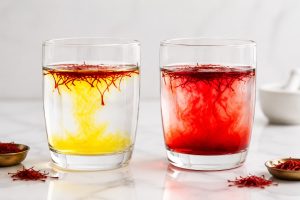
Cold water infusion test demonstrating the visual difference between genuine saffron and counterfeit dyed threads
Short Answer: Premium saffron consists of complete, unbroken threads with high coloring power and is classified in the highest quality category (Category I) according to international standards such as ISO 3632.
According to the international ISO 3632 standard, the maximum allowable impurity in premium saffron is only 0.5%, whereas this percentage is higher for Grade II and III. This means premium saffron must be nearly pure, containing minimal yellow style or non-useful plant matter. “Sargol” and “Super Negin” varieties typically fall into this premium category because their threads consist only of the crimson stigmas, without the white style.
The Three Golden Criteria: Color, Aroma, and Appearance
Short Answer: Authentic saffron features a deep crimson to brick-red color, a pungent and slightly bitter aroma (resembling honey and dried hay), and thin, uniform threads. If any of these three are missing or seem exaggerated, it is likely fake.
1. The Color of Real Saffron
When infused, real saffron releases its color gradually and naturally, not instantly. If you soak a product in cold water and it turns a deep color immediately, you are likely dealing with dyed saffron.
(Insert Image: Saffron Water Test here | Alt: Cold water test showing gradual saffron infusion)
2. The Aroma of Real Saffron
The scent of real saffron is a complex blend of mild bitterness, a specific pungency, and a fragrance reminiscent of honey and dried hay. Saffron that is odorless or has a very weak scent is usually old or low quality.
3. The Appearance of the Threads
Authentic saffron threads are thin, funnel-shaped, and slightly wider at the ends. Consistency in both color and thread thickness is a sign of high quality.
Which Type Should You Buy: Negin, Sargol, Poushal, or Daste?
Short Answer: For daily household use, Sargol and Negin are the best choices due to their high coloring power and minimal white style. Poushal is more economical but has lower coloring intensity, while Daste (Bundle) saffron is the least likely to be adulterated due to its intact structure.
| Saffron Type | Main Feature | Best For |
|---|---|---|
| Negin | Large, thick, deep red threads; very high coloring power | Premium gifts, restaurants, luxury use |
| Sargol | Only the red part of the stigma; no white style | Daily high-quality cooking & gifts |
| Poushal | Complete threads including some yellow style | Economical daily use |
| Daste (Bundle) | Untouched, intact threads; minimal processing | Buyers concerned about purity/adulteration |
If you are still unsure which type suits you best, you can compare our available varieties in our Iranian Saffron Products Section.
What Factors Affect the Price of Saffron?
Short Answer: The price of saffron depends on the type (Negin, Sargol, Poushal), quality grade, harvest year, coloring power, and purchase volume (retail vs. wholesale). Generally, the higher the purity and color intensity, the higher the price.
It is important to note that a lower price does not always mean the product is fake, but extremely low prices (significantly below market rates) are almost always a red flag. Producing just one gram of real saffron requires thousands of flowers, which sets a natural floor for the price of authentic saffron.
Why Choose Qaenat Saffron?
Short Answer: Qaenat, located in South Khorasan, is recognized as one of the most important and historic saffron-growing regions in Iran. Due to its ideal climate, Qaenat saffron is renowned for its exceptional color and quality.
The soil, climate, and centuries of expertise from Qaenat farmers have made this region a global benchmark for saffron quality. This is why many buyers specifically look for “Qaenat Saffron.” However, while geography is a strong indicator, it is not a guarantee of purity; every shipment should still be quality-checked.
Packaging: What to Look For When Buying
Short Answer: Proper saffron packaging should be airtight, light-resistant (dark-colored), and include details like harvest date, exact weight, and manufacturer information.
- Light Protection: Saffron should be stored in dark containers or pouches to prevent light degradation.
- Harvest Date: Always check the harvest year; fresher saffron offers much better quality.
- Accurate Weight: Ensure the weight on the package matches the actual content.
- Seller Credibility: When buying online, always verify the seller’s reputation and history.
Final Checklist for Buying Authentic Saffron
Before you pay, review this quick list:
- [ ] Threads are deep crimson/brick-red (not bright orange).
- [ ] Pungent, hay-like aroma (not odorless).
- [ ] Threads are thin, funnel-shaped, and mostly unbroken.
- [ ] Price aligns with market rates (not suspiciously low).
- [ ] Packaging is airtight, dark, and labeled with a harvest date.
- [ ] Purchased from a reputable, verified seller.
If you want to ensure your saffron stays fresh after purchase, check out our guide on Saffron Storage and Usage, as well as our comprehensive guide on The Correct Way to Infuse Saffron for Maximum Color and Aroma.
Summary
Buying authentic saffron doesn’t require deep expertise; you just need to know a few key details about color, aroma, type, and price. If you are still unsure which type is best for your needs, or if you want to purchase premium, guaranteed authentic saffron, simply Contact Us and our experts will guide you.
❓ Frequently Asked Questions (FAQ)
1. Where is the best place to buy authentic saffron?
The best option is to purchase from reputable sellers or established online stores with a transparent history and detailed product descriptions, rather than anonymous or street vendors.
2. Can cheap saffron be authentic?
Because of the labor-intensive production process, authentic saffron has a stable market price. A product priced significantly lower than the current market rate is usually suspicious.
3. Which is better: Sargol or Negin?
Both offer excellent coloring power. Sargol typically has finer threads, while Negin has thicker, larger threads. The choice is mostly based on personal preference and budget.
4. What is the best saffron for home use?
Grade-A Sargol or Negin is usually the best choice for home use due to its excellent balance of high coloring power and reasonable price.
5. What should I check when buying saffron?
Pay attention to the color, aroma, thread appearance, market-aligned pricing, and ensure the packaging is airtight, dark, and includes a harvest date.