
Best Saffron in the World: A Comprehensive Guide to Quality, Authenticity, and Iranian Saffron Exports
Iran is the global benchmark for pricing, quality assessment, and standardization. To see how to identify this premium quality in person, read our detailed guide on How to Identify Original Saffron.
Why is Iranian Saffron Considered the Best Saffron in the World?
Iranian saffron dominates the market due to a unique combination of ideal climatic conditions, fertile soil in regions like Khorasan and Qaenat, and millennia of traditional farming wisdom. This results in the highest concentrations of crocin (color-giving), safranal (aroma), and picrocrocin (flavor)—the primary scientific markers used to grade saffron quality.
If you want to know how to identify this superior quality when making a purchase, read the comprehensive guide on buying authentic Negin saffron, which covers pricing and authenticity testing.
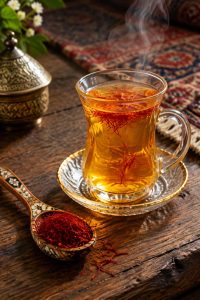
Crocin, Safranal, and Picrocrocin: The Scientific Secrets of Iranian Saffron’s Superiority
Crocin is responsible for the intense red color, safranal provides the distinct aroma, and picrocrocin delivers the characteristic bitter taste. The higher the concentration of these three compounds, the higher the quality and grade of the saffron. Iranian saffron, particularly the Negin and Sargol varieties, consistently achieves top scores across all three indices.
What is Crocin and Why Does it Determine Saffron Color?
Crocin is a water-soluble carotenoid responsible for the brilliant golden-red hue saffron imparts to food or liquids. The higher the crocin content, the more intense the color release with smaller quantities.
Measuring Crocin Based on the ISO 3632 Standard
The international ISO 3632 standard categorizes saffron based on light absorption into three grades. Premium Iranian Negin typically exhibits values between 220 and over 270.
| ISO 3632 Grade | Minimum Crocin Content | Iranian Saffron Range |
|---|---|---|
| Grade I (Highest Quality) | ≥ 190 | 220 to 270+ |
| Grade II | ≥ 150 | Some Poushal varieties |
| Grade III | ≥ 100 | Lower quality or aged saffron |
If you want to learn more about how to identify this quality when buying, don’t miss the article “How to Tell Real Saffron From Fake: 7 Simple Tests“
Qaenat and Khorasan: The Epicenters of Saffron Quality
A significant portion of Iran’s saffron superiority stems from regions like Qaenat (South Khorasan) and cities like Torbat-e Heydarieh (Razavi Khorasan). The combination of an arid climate, specific soil composition, and millennia of localized agricultural expertise makes these regions the world’s premier saffron producers.
Iran vs. Spain: The Historic Global Market Rivalry
While Iran is the world’s largest producer with a clear edge in intrinsic quality, Spain has carved out a powerful market position through sophisticated branding, repackaging of imported saffron, and extensive distribution across Europe. A substantial portion of the “Spanish saffron” sold in Europe and America is actually premium saffron imported from Iran.
Iran vs. Afghanistan: The Emerging Competition
In recent years, Afghanistan has expanded cultivation in Herat. Its production volume remains significantly lower than Iran’s,ron, and extensive distribution across Europe. A substantial portion of the “Spanish saffron” sold in Europe and America is actually premium saffron imported from Iran.
Iran vs. Afghanistan: The Emerging Competition
In recent years, Afghanistan has expanded cultivation in Herat. Its production volume remains significantly lower than Iran’s, and much to capture the added value.
Conclusion: Why Iranian Saffron Truly Remains the Best
Despite Spain’s branding prowess and Afghanistan’s emerging presence, the intrinsic quality of Iranian saffron—grounded in scientific standards like ISO 3632—keeps it at the top of the world.
If you wish to experience this premium quality directly without intermediaries, explore our range of Iranian Saffron Products or contact us for wholesale inquiries.
Frequently Asked Questions
1. Why is Iranian saffron considered the best in the world?
Due to its ideal climate, fertile soil, and long history of cultivation, resulting in the highest levels of crocin, safranal, and picrocrocin.
2. Which country produces the best saffron in the world?
Iran, which produces approximately 85-90% of the world’s saffron.
3. Is Iranian saffron actually better than Spanish saffron?
Yes, in terms of intrinsic quality (crocin and safranal levels), Iranian saffron is superior. Spain excels more in branding and marketing.
4. Why is Iranian saffron sometimes sold under a Spanish brand?
A large portion of Iranian saffron is exported in bulk to Spain, where it is processed, packaged, and marketed under Spanish brands.
5. What is saffron crocin and why is it important?
Crocin is the compound responsible for the deep red-gold color of saffron. The higher the crocin content, the higher the grade and quality.
6. Is Qaenat saffron better than Khorasan saffron?
Qaenat is widely recognized as the benchmark for premium quality, while the broader Khorasan region is a massive hub for both high-quality and large-scale production.