
What Is the Difference Between Negin and Sargol Saffron? + Comparing Pushal and Dokhtar-Pich | Saffron Traders
When shopping for saffron—whether at a physical market or an online store—the first point of confusion often arises from the different names: Negin, Sargol, Pushal, or Dokhtar-Pich. These aren’t merely marketing labels; each refers to a specific stage of saffron processing that directly influences the product’s appearance, price, and intended use. In this guide, we will thoroughly examine the differences between Negin, Sargol, Pushal, and even the lesser-known “Dasteh” (Dokhtar-Pich) varieties, helping you make a confident choice.
📌 Quick Overview:
Negin saffron consists of completely intact, large, and straight (flat-pressed) stigmas, free from even the slightest fragments or breakage, representing the highest grade in terms of appearance and export quality. In contrast, Sargol saffron is also 100% pure and all-red, but its strands are shorter and contain some broken pieces. There is no significant difference in aroma or flavor, yet Negin commands a higher price due to its luxurious appearance.
What is the difference between Negin and Sargol saffron?
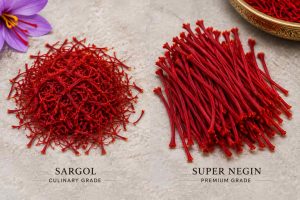
Visual difference between saffron threads: on the right, elongated and straight “Super Negin” stigmas; on the left, shorter “Sargol” threads with natural breaks.
Short answer: Negin saffron consists of large, smooth, unbroken stigmas with exceptional coloring power and aroma, making it more expensive; Sargol saffron also consists solely of red stigmas, but the strands are smaller and sometimes slightly broken, making it more economical. In terms of flavor and coloring quality, there is little difference between them.
The most significant difference between Negin and Sargol saffron when buying lies in the appearance of the threads, rather than necessarily their intrinsic quality. Negin saffron is typically 15% to 35% more expensive than Sargol because its processing and sorting are more labor-intensive and result in more waste. For more information on how to distinguish the quality of these two types, please read the article: “A Complete Guide to Buying Authentic Negin Saffron: Price and Authenticity Tests.”
Distinguishing Negin Saffron from Sargol Saffron
The simplest way to distinguish them is by looking at the strands: *Negin* saffron consists of completely intact, straight, and elongated threads with no visible breakage. In contrast, *Sargol* saffron features shorter strands—sometimes including fragments and fine particles—since it is obtained by sifting through *Pushal* or *Dasteh* (bunch) saffron. This visual difference is directly linked to scientific grading under the ISO 3632 standard; the more intact and uniform the strands, the more likely the saffron is to fall into the highest quality category.
What is Pushal saffron, and how does it differ from Sargol and Negin?
In short: *Pushal* saffron consists of the entire stigma strand along with a portion of the yellow style (the “root”); in other words, the parts have not been fully separated. This characteristic makes it easier to verify its authenticity and reduces the likelihood of adulteration compared to *Sargol* or *Negin* varieties, as the natural structure of the strand remains intact. The most significant advantage of *Pushal* saffron is the guarantee of 100% authenticity; the natural attachment of the red stigma to the style proves that the product has not been tampered with and contains no artificial dyes. For this reason, many households choose *Pushal* for everyday cooking, valuing its cost-effectiveness and the assurance of its purity.
Pushal performs well in terms of coloring, though—since a portion of its weight consists of the colorless style—it releases slightly less color per gram compared to Sargol and Negin. If you want greater assurance regarding authenticity and are looking for something for everyday home use, Pushal is a reliable choice.
Bunch Saffron (Dokhtar-Pich); the most authentic type of saffron.
“Bunch” or “Dokhtar-pich” saffron represents the most natural form of the spice; it consists of complete stigma strands attached to the style—without any separation—traditionally bound together with thread. Because the structure of the strands remains entirely intact, there is virtually no possibility of adulteration. In exchange for this assurance, the proportion of the style is higher, resulting in a slightly lower coloring strength per gram compared to the other three varieties.
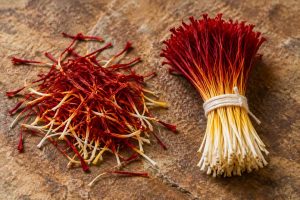
A close-up view of *Pushal* and *Dokhtar-pich* saffron strands; the presence of a white root at the base of the stigma is the most important indicator of authenticity and a safeguard against adulteration for these two types of saffron.
| Saffron Grade | Visual Appearance | Purity (Root/Style) | Best Use | Value |
|---|---|---|---|---|
| Super Negin | Thick, long, and perfectly straight red threads. | None (All Red) | Gifts & Professional culinary use. | Premium |
| Sargol | Shorter, broken threads; purely red. | None (All Red) | Daily household cooking. | Moderate |
| Poushal | Red stigma with 1-3mm of yellow/white root. | Present (Authentic) | High-value consumption. | Economic |
| Bunch (Dokhtar-Pich) | Entire thread (Red stigma + full white style). | High (Full Root) | Traditional & Fraud-proof. | Budget |
Should You Buy Negin or Sargol Saffron? (A Quick Selection Guide)
To make the best decision, we recommend keeping these two simple criteria in mind:
1- If you are purchasing for export, as a gift, or for formal entertaining: Without a doubt, choose *Negin* or *Super Negin* saffron. Its eye-catching appearance, featuring long, large stigmas, significantly enhances the value of the packaging.
2- If you are purchasing for home use, cooking, or baking: *Sargol-e Momtaz* (Premium Sargol) saffron is the smartest choice; it imparts the same flavor, color, and aroma to your dishes without the extra cost associated with the size and uniformity of the stigmas.
Why is Negin saffron more expensive than Sargol?
The short answer: The price difference between Negin and Sargol saffron typically ranges from 15% to 35%. This is due to higher processing costs, greater waste during the separation of intact strands, and strong export demand for Negin.
Three main factors drive this price gap: first, the difficulty of processing and sorting to achieve perfectly straight, unbroken strands; second, the absence of “fines” or broken fragments in Negin (whereas Sargol always contains a certain percentage of them); and third, heavy export demand for Negin and Super Negin saffron, which keeps global prices high. Reports on the Iranian saffron export market confirm that Negin consistently trades at a higher price than Sargol and Pushal for precisely these reasons.
Which type of saffron is best for export?
In short: Negin and Super Negin saffron are more popular in the luxury markets of Europe and the US due to their flawless appearance, whereas Sargol saffron is primarily used in industrial, restaurant, and general retail sectors.
This market distinction is directly linked to a topic we previously explored in the article “Why Is Iranian Saffron Considered the Best in the World?“; as noted there, a significant portion of Iran’s saffron exports consists of Grade 1 Negin saffron, which is subsequently repackaged in countries like Spain.
Frequently Asked Question: Does bunch saffron have less color?
No, the coloring power of the red stigma itself is the same; however, since the style (the colorless yet highly aromatic part) accounts for about 30% to 35% of the weight of “bunch” saffron, it releases less color than *Sargol* or *Negin* saffron for the same total weight. Consequently, it is more economical.
Conclusion: Which saffron should we buy?
None of these four types is “absolutely superior” to the others; the right choice depends on your specific needs. If you are looking for a luxurious appearance—ideal for formal occasions or export—*Negin* is the best option. For everyday household use with a balanced budget, *Sargol* is a smart choice. And if ensuring authenticity is your top priority, *Poushal* or *Dasteh* offers the greatest peace of mind. To view and compare all four types side-by-side, check out our Iranian saffron products; or, if you are still unsure which option suits you best, simply contact us, and our experts will guide you.
Frequently Asked Questions About Types of Saffron
1. Is Negin saffron better, or Sargol?
There isn’t much difference in terms of aroma and flavor; *Negin* has a more luxurious appearance and a higher price point, whereas *Sargol* is more economical for daily use.
2. Is Pushal saffron of lower quality?
No, it has good coloring quality; it just differs in appearance from *Sargol* and *Negin* grades, as it retains some of the yellow style (the “cream”) along with the red stigma.
3. What is “bunch saffron,” and why is it cheaper?
“Bunch” or “Dokhtar-pich” saffron consists of the entire stigma strand attached to the style, without separation; because it contains a higher proportion of the style, its coloring power—by weight—is lower, and its price is correspondingly lower.
4. Which saffron has a stronger aroma?
The aroma of saffron depends more on the quality and freshness of the threads than on the specific grade (Negin, Sargol, or Pushal); however, *Dasteh* (bunch) saffron—due to the presence of the style—often has a longer-lasting aroma.
5. Which type of saffron is best for export?
Negin and Super Negin saffron are usually preferred for export and luxury markets due to their flawless appearance and large stigmas.