
Iran’s Saffron Exports: Challenges, Permits, and Global Market Profits
Despite holding a 90% share of global production, Iran’s saffron exports suffer from low value-added returns due to raw bulk selling, weak branding, and banking sanctions. The primary opportunity lies in exporting packaged and processed saffron to markets in Europe, China, and the Persian Gulf—a strategy that can multiply profits several times over.
Iran has been the uncrowned king of the global saffron market for centuries; however, the reality rarely discussed is that this king pockets a negligible share of the industry’s total profit. While Iranian saffron, after leaving the country, is packaged under Spanish labels or Emirati brands and sold at prices many times higher to the end consumer, the Iranian exporter often secures only the thin margin of a raw commodity.
In this article, we intend to examine both sides of the coin without slogans and with a business-oriented perspective: the challenges that have long hindered the actual profitability of Iranian exporters, and the opportunities that, if correctly identified, can transform the position of Iranian merchants in the global saffron value chain.
Current Status and Capacities of Iranian Saffron Export
Direct Answer: Iran produces over 90% of the world’s saffron, making it one of the country’s primary non-oil export products after carpets and caviar. However, Iran’s share of the lucrative packaged saffron trade is significantly lower than its actual share in production.
The core center of global saffron production is South Khorasan and Razavi Khorasan provinces; a region whose climate makes it the best origin for cultivating this plant. If you are not yet familiar with the types and qualities of Iranian saffron, our article “What is the Difference Between Negin and Sargol Saffron?” explains how this product variety directly affects export pricing and the target market.
But the real numbers are as follows:
- Iran is the world’s largest producer and exporter of saffron.
- Major buyers of Iranian saffron include China, Spain, the UAE, India, and Arab countries.
- A vast majority of exports are conducted in bulk and without branding; exactly the part of the chain with the lowest profit margin.
To better understand Iran’s position in this industry, the article “The Best Saffron in the World in Your Hands” provides a complete picture from Iranian farms to international markets.
Major Obstacles and Challenges Facing Saffron Export
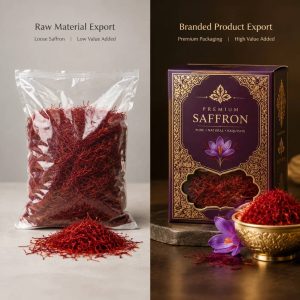
Raw saffron selling versus branded packaging; the key to increasing profitability in international markets.
Direct Answer: The most significant obstacles to Iranian saffron exports include raw and bulk selling, banking sanctions and currency repatriation requirements, weak branding, market-making by competitors like Afghanistan and Spain, and complex customs and standardization requirements for entry into European markets.
1. Consequences of Bulk Selling in Saffron Export
Direct Answer: In raw saffron export, Iran exports the product in bulk at a low price. The foreign buyer, after packaging and branding, sells it to the end consumer for 3 to 10 times the price; meaning the main value-added remains at the destination.
Trade data shows that a significant portion of Iran’s exported saffron is sent in bulk to intermediary countries such as Spain and the UAE. These countries perform re-packaging and branding operations, selling the same Iranian saffron at several times the price in Europe and North America. Simply put: We sell the product; others sell the story.
This is while even inside Iran, there is a distinct buying market for specific qualities, and if you do not understand the distinction between product types, you will lose the upper hand in export negotiations; our guide to Buying Authentic Saffron and Testing Authenticity is a prerequisite for every merchant from this perspective.
2. Sanctions, Currency Repatriation, and Revenue Barriers
Direct Answer: Banking sanctions have made transferring saffron export revenue complex and costly, and the currency repatriation policy obligates exporters to return foreign currency at specified rates; these two factors reduce profit margins and the incentive for official exports.
The reality of the market is that when an exporter cannot easily transfer their foreign currency earnings or spend them freely, a portion of the trade is conducted unofficially. This event has two negative consequences: First, Iranian saffron leaves the country without an official identity and under the destination’s brand; Second, the possibility of state support and the aggregation of export data is lost.
3. Competition from Afghanistan and Market-Making by Spain
Direct Answer: Afghanistan, with extensive cultivation and lower prices, has become a direct competitor in neighboring markets, and Spain, through strong branding, has introduced itself as the reference for global saffron quality; while a major part of Spanish saffron is originally Iranian.
Smuggling and unofficial exit of saffron to Afghanistan and reselling it under that country’s brand effectively means gifting the Iranian brand’s reputation to a competitor. In contrast, Spain, with precise packaging standards and professional marketing, has built a position in the European consumer’s mind that even makes its imported saffron appear “Spanish.” The roots of this problem lie in the lack of investment in branding and product storytelling, not in quality.
4. Customs, Tax, and Standardization Complexities
Direct Answer: Official saffron export requires a business card (trading license), standard permits, health certificates, and quality tests. The complexity of this process is a barrier to entry for novice merchants, leading to a tendency toward unofficial methods.
Part of this complexity is inevitable, and part of it can be overcome with the right knowledge. In the final section of this article, we have provided an operational checklist for this very path.
Target Markets and Commercial Potentials for Saffron Export – Where can you get multi-fold profits?
Direct Answer: The primary opportunities for Iranian saffron exports include emerging markets in China and India, shifting from bulk to packaged exports, entering global pharmaceutical and cosmetic industries, and direct Iranian branding in European and Persian Gulf markets.

Examining demand data, trade routes, and the world’s largest saffron importers.
1. Powerful and Emerging Export Markets
Direct Answer: China is the largest and fastest-growing market for Iranian saffron, and markets in Dubai, Oman, Qatar, and European countries—due to high consumption in food and pharmaceutical industries—are considered the most profitable destinations for packaged exports.
- China: Massive demand in traditional medicine, food industries, and cosmetics; suitable for export with guaranteed quality and pharmaceutical packaging.
- Persian Gulf (Dubai, Oman, Qatar): Consistent buyer of premium Negin saffron with gift packaging; a suitable market for the Iranian brand.
- Europe: Difficult entry but highly profitable; requires standards and a brand, but with profit margins several times higher than bulk export.
- India and Southeast Asia: High consumption in food and religious industries; primarily a volume-driven market.
2. Moving Beyond Bulk Selling; The Real Profit is in Packaging and Branding
Direct Answer: The price difference between bulk saffron and packaged export saffron in European and Persian Gulf stores sometimes reaches 5 to 10 times; meaning the entire significant profit margin lies in the layer of packaging, branding, and marketing, not the product itself.
The following table shows the true picture of this value gap:
| Value Chain Stage | Product Form | Approx. Retail Price | Profit Margin Share |
|---|---|---|---|
| Export from Iran | Bulk saffron in kilo packs | Global base price (Lowest) | Exporter margin: Low |
| Intermediary (Spain/UAE) | Repackaging & Standardizing | 2 to 3 times bulk price | Medium to high profit |
| Final Retail (Europe/Arab) | Branded, 1-5g packs | 5 to 10 times bulk price | Highest in the chain |
(Figures are approximate and based on general global market averages, and change depending on quality, harvest year, and exchange rates.)
Key Point: Entering the upper layers of this table requires not large capital, but knowledge of standardization and marketing. To understand the quality criteria that buyers accept in this space, our category on Quality and Saffron Authenticity Testing is a good starting point.
3. Medicinal and Processed Saffron; A Major Overlooked Opportunity
Direct Answer: The market for medicinal, extract, and cosmetic saffron is growing rapidly. Exporting tablets, extracts, and processed saffron products carries value-added several times higher than bulk exports, and Iran, possessing the raw material, has a privileged position to enter.
Numerous scientific studies have been published regarding the therapeutic properties of saffron; from mood enhancement to strong antioxidant properties. If you are interested in this field, the article Properties and Health Benefits of Saffron is a good overview of existing scientific evidence. For industrial and pharmaceutical buyers in European markets, it is exactly these scientific documents that form the basis for negotiation and pricing.
4. Branding Iranian Saffron Abroad
Direct Answer: Branding Iranian saffron means selling the product with a story of authenticity, geographical origin, and standard packaging instead of selling without a name. This strategy multiplies the sales price and customer loyalty in target markets.
India has built a brand for “Darjeeling” tea and Spain for its imported saffron; Iran, with the strongest raw material in the world, has yet to take this seriously. Every exporter who builds standard packaging, brand identity, and direct sales channels in the destination today is effectively capturing a share that has long been ceded to others.
Required Documents and Permits for Saffron Export; Operational Checklist
Direct Answer: For official saffron export, you need a business card, order registration, standard permit, health and quarantine certificate, laboratory analysis (Crocin content), and customs declaration. The global quality standard for saffron is ISO 3632.
Step-by-step checklist to start saffron export:
- Business License: Register in the comprehensive customs portal and obtain a valid business card.
- Order Registration: Declare goods with the relevant HS Code for saffron in foreign trade systems.
- Laboratory Test: Measure Crocin (coloring), Picrocrocin (flavor), and Safranal (aroma) content based on ISO 3632 standards — this standard ranks saffron from category 1 (highest quality) to category 3.
- Standard & Health Permits: Obtain the Iranian national standard certificate and health export permit.
- Destination-Compliant Packaging: Standard food packaging with bilingual labeling and origin specifications.
- Customs Declaration: File in the origin customs and select Incoterms.
- Currency Repatriation: Track currency commitment obligations in the Central Bank system.
If your source of purchase is Khorasan farms, be sure to confirm the authenticity and quality grade of the product before signing a contract; the article Identifying Authentic Saffron from Fake; 7 Simple and Reliable Methods is vital for this stage.
Comparison: Bulk Export or Packaged Export?
Direct Answer: Bulk export requires less initial capital and has lower risk but generates limited profit margins; packaged export demands more capital, knowledge, and permits, but brings significantly higher profit and brand credibility.
| Criterion | Bulk Export | Packaged/Branded Export |
|---|---|---|
| Initial Capital | Low | Medium to high |
| Profit Margin | Low | 3 to 10 times |
| Currency Repatriation Risk | Higher (Dependent on intermediaries) | Manageable with direct contracts |
| Standard/Permit Requirement | Minimal | Full (ISO 3632, Health, Labeling) |
| Market Durability | Unstable, price competition | Sustainable with loyal customers |
Conclusion; The Future of Iranian Saffron Export is in the Exporters’ Hands
Direct Answer: The future of Iranian saffron export depends on moving from bulk selling toward branding, processing, and packaged export. Global markets have grown; the difference lies only in who reaps the profit of this growth: Iran or intermediaries.
Iranian saffron has no rivals in terms of quality and authenticity; what is required is changing the perspective from “seller of raw product” to “builder of a global brand.” Those who enter this path today will build this industry ten years from now.
If you intend to start wholesale buying or exporting, you can examine our Iranian Saffron Products to review export-grade Negin and Sargol types; or for expert consultation on buying and selecting products suited to your target market, contact Saffron Traders experts via our CIran’s Saffron Exports: Challenges, Permits, and Global Market Profitsontact Us page.
Frequently Asked Questions (FAQ)
1. Which countries are the largest buyers of Iranian saffron?
China, Spain, the UAE, India, and Arab Persian Gulf countries are the largest export destinations for Iranian saffron. China as a growing market and the UAE as a redistribution hub hold special importance.
2. How much is the profit from exporting saffron?
Profit depends on the export format: In bulk export, margins are usually limited, but in packaged and branded exports, the final retail price is 5 to 10 times the bulk price, multiplying the profit margin.
3. How much “luggage saffron” (passenger export) is allowed?
Based on customs regulations, a limited amount of saffron is allowed for personal use accompanying a passenger; however, high-volume trade without customs declaration and official documents is considered smuggling and includes seizure and penalties.
4. What is ISO 3632 and why is it necessary for export?
It is the international standard for saffron quality that ranks the product into three categories based on Crocin, Picrocrocin, and Safranal levels. Most European and industrial buyers consider presenting the results of this standard a condition for contract.
5. Where to start for exporting saffron to Europe?
First, obtain a business card, prepare ISO 3632 and health permits, then—with packaging and labeling compliant with European Union regulations—enter negotiations with importers or start direct online sales.