
What Is Saffron Crocin? Coloring Strength and the ISO 3632 Standard
If you have ever shopped for premium Iranian spice, you have likely come across terms like “coloring strength” or “crocin value” with suppliers advertising figures like “our saffron features a crocin level of 240+.” But what does this numerical index actually signify, and why is it so pivotal? Crocin in saffron is the key carotenoid compound responsible for its radiant golden-red pigmentation and represents the primary international laboratory benchmark for grading. In this comprehensive guide, we unpack what crocin is, its standard classifications under ISO 3632, how it distinguishes itself from safranal and picrocrocin, and how to accurately interpret commercial laboratory certificates before you order bulk saffron products.
What is Crocin in Saffron?
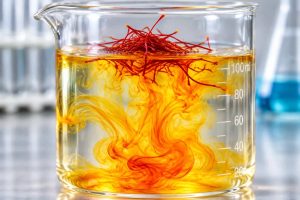
Dissolution test for authentic saffron crocin in water
In brief: Crocin represents a group of natural water-soluble carotenoid glycosides concentrated in the stigmata of the Crocus sativus flower. It is the sole agent behind the celebrated red-orange hue saffron imparts when diffused in liquids. Chemically speaking, crocins are diesters constructed from the dicarboxylic acid crocetin bonded with glycosyl residues (principally gentiobiose and glucose).
Unlike oil-soluble carotenoids or synthetic artificial food dyes, crocin dissolves effortlessly in pure water. This rare biological trait turns it into an exceptional natural colorant for high-end gastronomy, confectionery, and modern pharmacological formulations. Beyond coloring power, clinical studies documented by the National Center for Biotechnology Information (NCBI) underline crocin as a potent therapeutic antioxidant known for neuroprotective, anti-inflammatory, and mood-stabilizing properties. For a wider perspective on these clinical virtues, explore our in-depth report on the health properties and benefits of saffron.
How is Crocin Measured? The ISO 3632 Standard
To establish uniform international commerce and safeguard buyers against spice adulteration, the International Organization for Standardization established ISO 3632 (parts 1 & 2). This standard mandates UV-Vis spectrophotometry to quantify the three primary biochemical markers in dried saffron filaments.
The standard analytical procedure follows these rigorous steps:
- A precise sample of dried saffron is finely pulverized and blended into pure distilled water.
- The aqueous extract is filtered and transferred into an optical quartz cuvette.
- Absorbance is recorded at specific wavelengths: 440 nm for crocin (color intensity), 257 nm for picrocrocin (bitter taste), and 330 nm for safranal (aroma).
- The resulting coloring capacity index is stated mathematically as:
ISO 3632 Quality Grading Table for Crocin
According to ISO 3632-1 technical specifications for whole saffron filaments, commercial saffron batches are classified into four distinct quality grades based on minimum crocin readings:
| Category / Grade | Minimum Crocin ($A_{1cm}^{1\%}$ at 440 nm) | Corresponding Commercial Type | Target Market Application |
|---|---|---|---|
| Category I (Grade 1) | ≥ 200 | Super Negin / Premium Sargol | Top-tier Export & Pharmaceuticals |
| Category II (Grade 2) | 170 – 199 | Negin / Standard Sargol | Commercial Food & Retail Packaging |
| Category III (Grade 3) | 120 – 169 | Pushal | Industrial Blending & Catering |
| Category IV (Grade 4) | < 120 | Dasteh (Bunch / Dokhtar-Pich) | Domestic Culinary Infusions |
To better grasp how physical cutting influences these readings, read our breakdown on the difference between Negin, Sargol, Pushal, and Dokhtar-Pich. Freshly dried Super Negin lots frequently register between 240 and 270. Be cautious of figures claiming 300+ without an accredited laboratory audit, as extreme values often point toward dye adulteration.
Crocin vs. Safranal vs. Picrocrocin: The Essential Trio
Authentic saffron relies upon an intricate chemical balance. Each active constituent delivers a distinct culinary and sensory role:
- Crocin (Color): Produces the vivid crimson visual tone and yellow-gold infusion. It is completely odorless on its own. Releasing its full potential requires proper preparation techniques; see our guide on the proper way to brew saffron for aroma and color.
- Picrocrocin (Flavor): Imparts saffron’s signature earthy, slightly bitter taste. During gradual curing and heat treatment, picrocrocin partially breaks down to yield safranal.
- Safranal (Aroma): The volatile monoterpene that forms saffron’s warm, sweet, hay-like fragrance. Freshly gathered filaments often test with record-high crocin but subtle scent, developing intense aroma only after adequate drying and resting.
Key Factors That Influence Crocin Values in Saffron
Why do two batches harvested in the same region yield completely different crocin numbers? Several agricultural and processing variables determine the final score:
- Dawn Harvesting: Blooms must be picked early at sunrise before direct sunlight causes solar photo-oxidation of delicate crocin chains. Iranian farms known for producing the best saffron in the world operate on strict early-morning harvesting schedules.
- Drying Technology: Modern industrial dehydrators dry stigmas in minutes, conserving up to 30% more crocin compared to slow open-air drying on traditional fabrics.
- Floral Anatomy: Crocin resides purely in the red stigma heads. Variations containing yellow styles (like Pushal or Dasteh) inevitably dilute the net reading by weight.
- Post-Harvest Preservation: Crocin degrades under exposure to thermal heat, atmospheric moisture, and ultraviolet rays. Review our vital guide on how to store saffron to protect aroma and color.

How to Verify a Saffron Certificate of Analysis (COA)
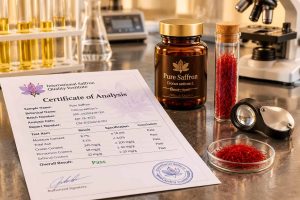
Laboratory Report on Saffron Quality and Authenticity
Whether evaluating retail packages or conducting transactions in Iran’s saffron export and trade market, always verify these three benchmark criteria on the lab COA:
- Coloring Strength ($A^{1\%}_{1cm}$ at 440 nm): Must surpass 200 for Grade 1 classification (typically 230–260 for elite Super Negin).
- Moisture Content: Must not exceed 12% by weight (optimal moisture is between 7% and 9%). Excess humidity artificially inflates parcel weight and triggers rapid enzymatic breakdown. This metric directly impacts pricing models; discover more in our review on factors affecting authentic saffron prices.
- Adulteration Screening: The laboratory report must confirm total absence of artificial food colorants (e.g., Tartrazine, Sunset Yellow, Sudan dyes). For simple screening at home, check our practical methods on how to tell real saffron from fake using simple tests.
For certified wholesale purchases or custom export specifications, you can always consult with our specialists via the Saffron Traders contact page or learn about our supply chain background on the about us page.
Frequently Asked Questions
What is a good crocin number for saffron?
Under ISO 3632 guidelines, any value exceeding 200 earns Category I (Grade 1) certification. Premium export Super Negin typically scores between 230 and 265.
Does higher crocin guarantee stronger aroma?
No. Crocin governs pigmentation, while safranal generates aroma. Freshly harvested saffron frequently yields outstanding crocin numbers while having a delicate aroma that matures over weeks of proper storage.
Can crocin concentration decrease over time?
Yes. Crocin molecules naturally break down when subjected to thermal heat, air, moisture, and UV light. Storing saffron in airtight, opaque glass containers placed in a cool, dark pantry preserves crocin potency for years.
Can you measure crocin without laboratory equipment?
While an exact numerical grade requires UV-Vis spectrophotometry, you can visually test purity at home: drop filaments in warm water. Genuine saffron gently releases a transparent golden-yellow tint while strands retain their deep crimson hue, without turning cloudy or releasing rapid red swirls.